Melbourne Sunset Golden Hour Wedding Photography Session
Melbourne Sunset Golden Hour Wedding Photography Session
Melbourne Golden Hour Wedding Photography: How To Shoot The Sunset Window That Everyone Chases
There is a reason golden hour is the most booked time slot for wedding photography in Melbourne. The light does something no other time of day can do. It turns skin to gold, makes white dresses glow, and wraps the whole city in this warm, honeyed tone that feels like the world is holding its breath. Melbourne’s golden hour in particular has a quality to it that photographers from overseas constantly talk about. The air is cleaner here, the light is softer, and the city skyline catches the last sun in a way that creates silhouettes and reflections you will not find anywhere else. But here is the thing most couples do not realize: golden hour in Melbourne is only about 20 minutes of usable light, and if you do not plan for it, you will spend the whole session chasing a sun that already set.
What Makes Melbourne’s Golden Hour Different From Everywhere Else
Golden hour exists in every city on earth. But Melbourne gives you something most places do not: a long, low-angle sunset that stretches the warm tones across the sky for nearly half an hour. In cities closer to the equator, the sun drops fast and the golden window is 10 minutes, maybe 15. In Melbourne, especially in summer, the sun hangs low on the horizon from about 7:15pm to 8pm, and the light shifts through amber, orange, peach, and pink in a slow, gradual way that gives you time to actually shoot instead of panicking.
The other thing Melbourne has going for it is the Yarra River. Water reflects the sunset and doubles the warm tones in every frame. The city skyline across the river catches the last light and turns gold while the sky behind it burns orange and pink. That combination of reflected light and direct light creates a layered, multidimensional glow that flat-land cities simply cannot match.
The air quality in Melbourne also plays a role. The city sits far from heavy industry, and on a clear evening, the atmosphere is clean enough that the light travels through without getting muddied by haze or pollution. The result is a golden tone that is rich and saturated instead of washed out and pale. You get deep amber instead of pale yellow. That difference shows up in every photo.
The Color Shifts You Need To Watch For
Golden hour is not one color. It is a sequence. The first 10 minutes after the sun hits the horizon, the light is deep orange and the shadows are long and warm. This is the most dramatic window. Skin looks bronze, dresses look gold, and every shadow has a rich, saturated tone.
The next 10 minutes, the light shifts to peach and pink. The orange fades and the sky turns into a gradient of warm pastels. This is the most romantic window but it is also the shortest. The light is softer, the contrast is lower, and the tones are more delicate. This is when you want tight portraits, close-ups, and detail shots.
The last 5 to 10 minutes, the light goes blue and purple. This is not golden hour anymore, this is blue hour, and it is a completely different look. The sky turns deep blue, the city lights start popping, and the warm tones are gone. Some photographers love this window for its moody, cinematic feel. But if you came for golden hour, you need to be done before this starts.
The Best Melbourne Spots For Golden Hour Wedding Photos
You cannot shoot golden hour just anywhere. You need a location that faces west, has an unobstructed view of the horizon, and gives you something interesting to put in the frame besides a flat sky. Melbourne has a handful of spots that nail this every time.
St Kilda Beach And The Pier
St Kilda is the classic golden hour spot in Melbourne and it is classic for a reason. The pier extends west into Port Phillip Bay, which means you get open sky on one side and water reflecting the sunset on the other. The reflection doubles the orange. The pier itself gives you leading lines that draw the eye straight to your couple.
The palm trees along the Esplanade catch the golden light and create silhouettes that frame your couple without any effort. The beach crowds thin out by 6pm, so you get clean backgrounds. The sand turns gold in the low light, which means even the ground becomes part of the color palette.
Position your couple at the end of the pier or on the grass near the kiosk. The sun sets behind them, which means you get that rim light around their hair and shoulders that makes every portrait look editorial. The water in front of them reflects the sky, which fills in the shadows on their faces with soft, warm light. It is the kind of lighting setup that looks like it took a crew of ten people to build, but it is just the sun and the bay doing their thing.
Williamstown And The Bay
If you want a wider, more dramatic backdrop, head to Williamstown. The beach faces west and the view across the bay toward the city skyline gives you something St Kilda cannot. The sun sets over the water, and the city buildings catch the last light and turn gold one by one as the sun drops lower.
The old boat sheds along the waterfront add texture and character. Rusty metal, weathered wood, peeling paint, all of it looks incredible in golden light. Your couple can lean against a shed, walk along the jetty, or stand on the sand with the city behind them. Every angle works because the light is coming from behind and wrapping around everything.
The rocky outcrop near the point gives you foreground elements that anchor the frame. Dark rocks against an orange sky is one of the most reliable compositions in wedding photography. It never gets old because the light is different every single evening.
The Yarra River And Southbank
Southbank gives you something the beach cannot: urban golden hour. The river acts as a mirror, doubling every light in the skyline. The promenade is wide and open, which gives you room to breathe compositionally. The lights from the arts center, the casino, and the buildings across the water create a layered backdrop that looks incredible in any frame.
The pedestrian bridges are the real play here. Standing on a bridge with the river below and the city behind you gives you depth, leading lines, and reflections all in one shot. The bridge railings create natural frames. The water catches every color and turns it into a painted surface.
Get to Southbank by 6:30pm in summer. The light starts shifting around 7pm, and you want to be set up and shooting before the sun hits the horizon. The first 10 minutes of direct golden light on the river are the best. After that, the light softens and the reflections get more diffuse, which is beautiful but a different look.
How To Actually Shoot Golden Hour Without Wasting The Window
The light is gorgeous but it moves fast. If you show up at 7pm and start scouting locations, you are already too late. You need a plan before you arrive.
Scouting The Day Before
Walk your location the evening before your shoot. Find the exact spot where the sun will set relative to your backdrop. Note where the shadows will fall. Check if there are any obstructions like trees, buildings, or cranes that will block the sun at the critical moment.
Mark your spots with tape or a pin on your phone. Know exactly where your couple will stand, where you will stand, and what the composition will look like before the sun even comes up on shoot day. Golden hour does not give you time to figure things out. It gives you time to execute a plan you already made.
Check the exact sunset time. Weather apps give this down to the minute. Work backward from there. If sunset is at 7:45pm, you need to be shooting by 7:15pm at the latest. The best light is between 7:15pm and 7:35pm. After that, you are chasing a fading glow.
Camera Settings For Golden Hour
Shoot manual. There is no other option. The light is changing too fast for auto anything.
Start with an aperture of f/2.8 to f/4. You want the background to glow but you also want your couple sharp. Going wider than f/2.8 risks missing focus on eyes, especially if your couple is moving. Stopping down past f/5.6 lets in less light and you will need to compensate with ISO, which adds noise.
Shutter speed depends on whether you are handheld or on a tripod. Handheld, do not go below 1/125th of a second or you will get motion blur from your own hands. On a tripod, you can go as slow as you need. For walking shots, 1/60th to 1/100th usually works if your couple moves slowly.
ISO is where golden hour gets tricky. The light is dimming fast, which means you will need to push ISO higher as the session goes on. Start at ISO 400 to 800 and work your way up to 1600 or 3200 by the end of the window. Modern cameras handle this well. A little grain actually adds to the warm, film-like quality of golden hour photos. It looks intentional, not sloppy.
White balance is critical. Set it manually to around 5000K to 5500K. This keeps the orange tones warm and rich instead of letting the camera cool them down. If you shoot RAW, you can adjust this later, but getting it close in-camera gives you a better starting point. Auto white balance will try to neutralize the warm light and turn your golden hour into a flat, gray mess.
Backlighting Your Couple The Right Way
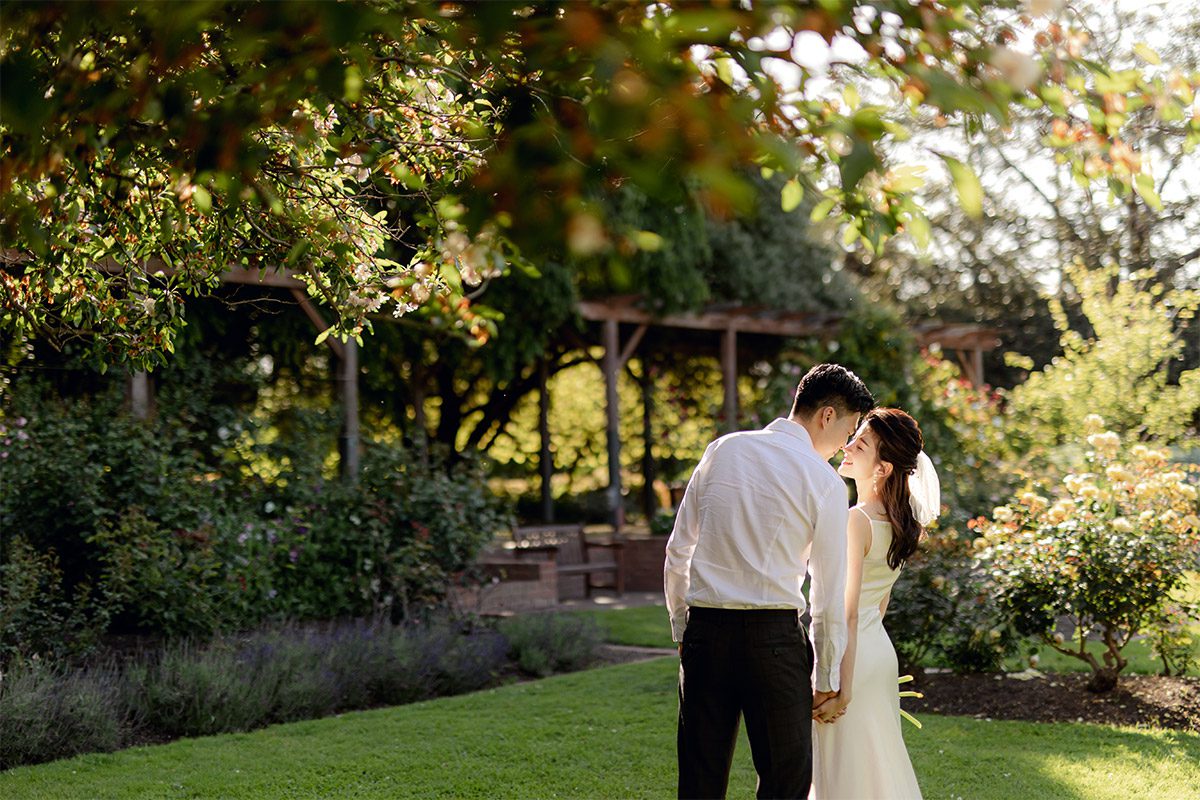
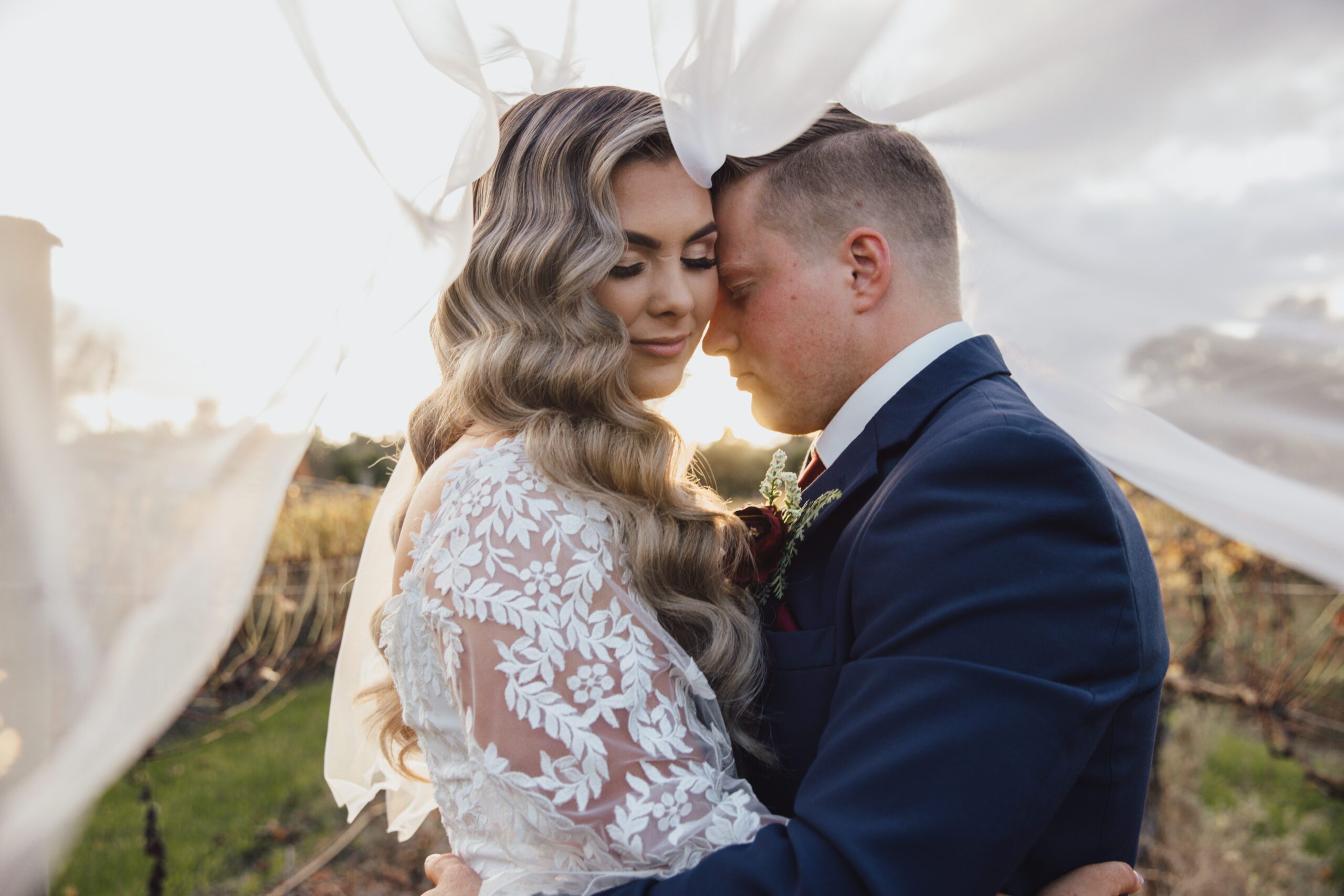
The move for golden hour is backlighting. Put the sun directly behind your couple and let it rim their hair, their shoulders, the edges of their dress. This creates that glowing outline that separates them from the background and makes them look like they are lit from within.
Do not put the sun dead center behind their head. That creates a blown-out white hole. Offset it slightly to one side. Let it peek out from behind a shoulder or through the branches of a tree. This gives you a controlled flare that adds warmth without washing out the image.
Expose for your couple’s faces, not the sky. The sky will be bright. That is fine. Let it be bright. Your couple’s faces are what matter. If the sky blows out to pure white, it looks clean and intentional. If your couple’s faces are dark because you exposed for the sky, the photo is ruined.
Use lens flare intentionally. A small amount of flare in the corner of the frame adds to the golden mood. Too much and it looks cheap. Find the balance by changing your angle slightly until the flare sits where you want it.
Common Mistakes That Kill Golden Hour Shoots
The first mistake is showing up late. I mean late. Golden hour in Melbourne moves fast, especially in summer when the sun drops quickly. If you arrive at 7pm for a 7:30pm sunset, you have lost your setup time. Arrive at least 45 minutes before sunset. Use that time to scout, compose, and let your couple settle in.
The second mistake is overshooting. You have maybe 20 minutes of peak golden light. Do not waste it taking 500 frames of the same pose. Take 20 good ones, then move on. Change the location, change the pose, change the composition. The light is shifting every minute, so every frame should look different from the last.
The third mistake is ignoring the couple. Golden hour is stressful. The light is fading, the clock is ticking, and everyone is rushing. But your couple needs to feel relaxed. If they are tense, the photos will look tense. Talk to them. Make them laugh. Give them something to do with their hands. The golden light will do the rest, but only if your couple is actually enjoying themselves.
The fourth mistake is not shooting into the sun. The best golden hour portraits have the sun behind or beside your couple, never in front of them. Front light in golden hour is flat and unflattering. Side light and backlight are where the magic lives. The sun should be your backlight, not your key light.
What To Do After The Sun Goes Down
Golden hour ends. The orange fades, the sky turns blue, and the city lights come on. Most photographers pack up and leave. But the next 15 to 20 minutes, called blue hour, is its own window.
The sky turns deep blue and the city lights turn warm yellow. That contrast between cool blue and warm yellow is one of the most beautiful color combinations in photography. Your couple stands in the blue light with the warm city glowing behind them, and the photo looks like it belongs in a film.
Shoot wide during blue hour. The city skyline is fully lit, the sky is still visible, and the light is soft and even. Your couple becomes a silhouette against the glowing city, or they are lit by a nearby streetlamp with the blue sky behind them. Either way, the photos are stunning and completely different from the golden hour shots.
You get two moods from one session. The warm, orange, romantic golden hour. And the cool, blue, cinematic blue hour. Tell your couple to expect both. The golden hour shots are what they came for. The blue hour shots are what they will not stop posting on Instagram.