The twenty-minute family photo block
Twelve groups in twenty minutes is ordinary. The same twelve groups take an hour when nobody is calling names — and that hour comes out of your couple portraits.
Why it overruns — and it is not the list
The standard advice is to cut the list. It is not wrong, and it is not the actual problem. A well-run block of twelve groups takes twenty to twenty-five minutes. A badly run block of six can take forty.
Watch where the time actually goes and it is never the photographing. Each frame takes perhaps forty seconds. What takes four minutes is finding Uncle Peter, who is at the bar, while eleven people stand in the sun waiting and two of them wander off to find their drinks, at which point you need to find them as well.
So the fix is not a shorter list. It is removing the search step — which takes one person, one page, and five minutes of planning a fortnight out.
The one job that fixes it
Somebody has to say, loudly, “Group four — Sarah’s parents, Sarah’s brother, and the grandparents. Everyone else, two steps back.” That sentence is the entire difference between twenty minutes and an hour.
It should not be your photographer. They do not know that Peter is Peter, they cannot see past the group they are lighting, and every second they spend scanning a crowd for a name is a second they are not making the photograph. Handing them a list and expecting them to also be the caller is the single most common reason this block overruns.
It should not be you either. You are in every single frame, which means you cannot go and fetch anyone, and the two of you are the least able to hurry your own relatives.
Ask an aunt, a sibling or an usher — someone who knows both families by name and does not mind raising their voice. Ask them a fortnight before, not on the day, and give them the printed page. It is the easiest job at a wedding and one of the most useful.
The stacking trick
The second half of the fix is the order. Most lists are written by importance — parents, then grandparents, then siblings, then the wedding party. That order makes the whole group disperse and re-form between almost every frame.
Order them so each group differs from the last by one or two people. Start with the largest group while everyone is still standing together, then peel outwards. Nobody walks away and comes back.
There is a kindness built into this order too: grandparents get released first. Standing on grass in formal shoes for twenty-five minutes is genuinely hard at eighty, and putting them in groups one to five means they are sitting down with a drink while the siblings are still being arranged.
The running order, ready to print
Twelve groups, stacked. Replace the names with your own, print it, and give it to the caller. The right-hand column is the instruction they read out — that is the column that does the work.
- 1Couple + both sets of parentsEveryone named is already here
- 2Couple + Partner A parentsB parents step out
- 3Couple + Partner A parents + siblingsA siblings step in
- 4Couple + Partner A whole familyA grandparents step in
- 5Couple + Partner A grandparentsOthers step out — grandparents released first
- 6Couple + Partner B parentsA side out, B parents in
- 7Couple + Partner B parents + siblingsB siblings step in
- 8Couple + Partner B whole familyB grandparents step in
- 9Couple + Partner B grandparentsOthers out — grandparents released
- 10Couple + all siblingsBoth sets of siblings in
- 11Couple + wedding partyFamily out, wedding party in
- 12Couple aloneEveryone released to canapés
What each extra group costs
Groups are not equal. Adding a fourth grandparent combination costs almost nothing; adding “everyone from the bride’s work” costs six minutes, because twelve people have to be found. This is the arithmetic worth doing before the list is final.
| Typical time | Why | Worth it? | |
|---|---|---|---|
| Group that differs by 1–2 people | 40–60 seconds | Nobody moves except the people named | Yes — this is the whole point of stacking |
| Group needing a full reassemble | 2–4 minutes | Everyone disperses and has to be gathered again | Only if it is a photo someone will print |
| Extended family (10+ people) | 4–6 minutes | Finding people, then arranging heights and gaps | Usually one is enough — do it first, while everyone is still there |
| Anyone who has to be fetched from the bar | 3–5 minutes each | Pure search time. Adds nothing to the photograph | Avoidable entirely — this is what the caller prevents |
| Whole guest list photo | 8–15 minutes | Needs height, a wide space, and a lot of herding | Only if you truly want it. Budget for it separately |
Read the last column of that table honestly and most lists shrink on their own. The test we suggest to couples: for each group, who would print this? If the answer is nobody, it is on the list because a template put it there.
Where to stand, and when
Three practical things that your photographer will otherwise have to solve on the spot, with an audience.
Pick the spot before the day. Open shade with an even background — a hedge, a wall, a row of trees. Not dappled light under a tree, which puts bright patches on people’s faces and cannot be fixed afterwards. Ask your photographer to nominate it when they arrive and tell the caller where it is.
Do it immediately after the ceremony. Everyone is in one place, dressed, and has not started drinking. Fifteen minutes later they are spread across a lawn with glasses in their hands and the block doubles.
Tell guests it is happening. One line from the celebrant at the end of the ceremony — “family photos on the terrace now, everyone else canapés on the lawn” — saves more time than anything else on this page.
What it looks like when it runs
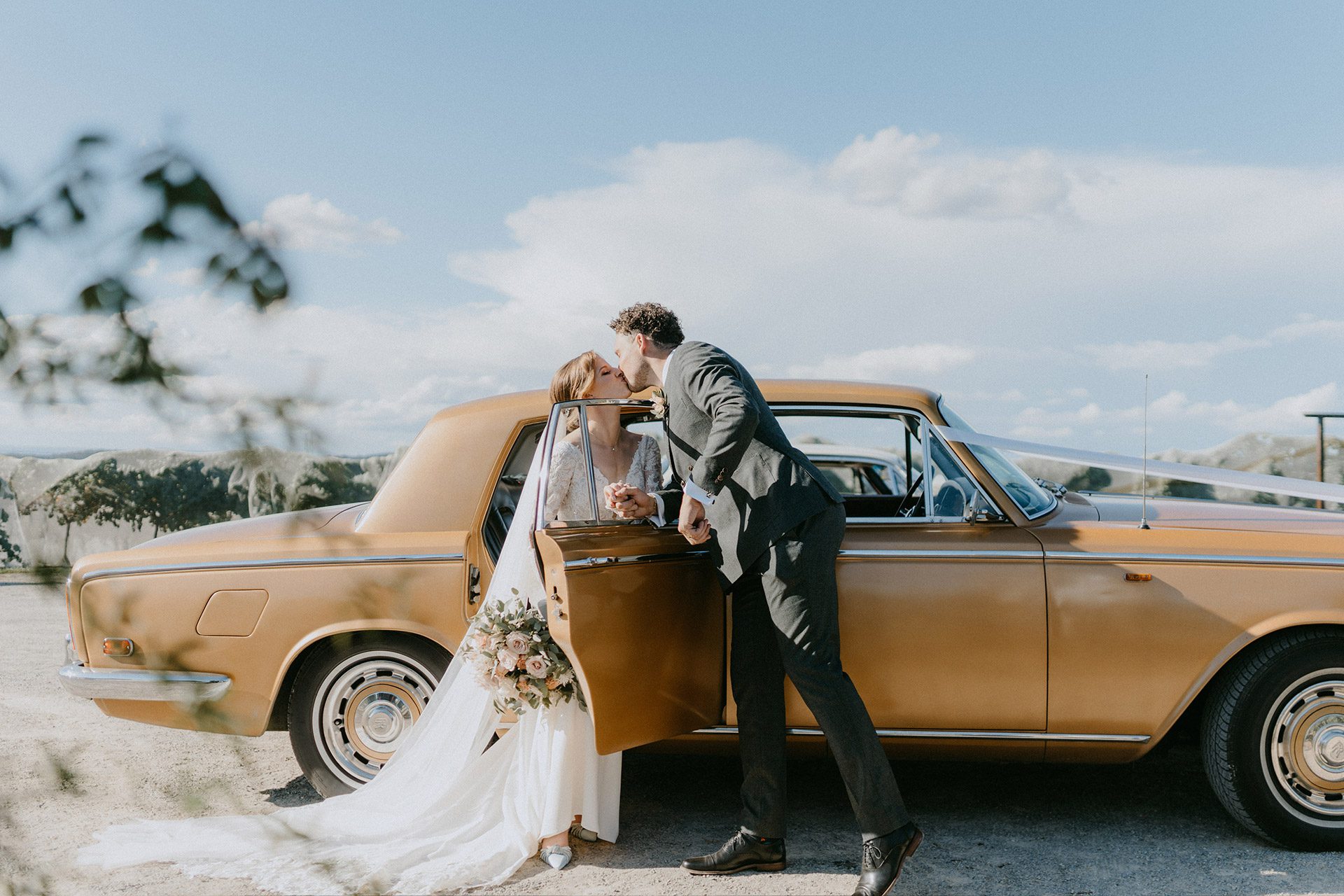
The difference is visible on film as much as in the photographs. A block that runs shows people talking to each other between frames; a block that does not shows people checking their phones and looking for shade.
A wedding where the formal block ran to time — and the day kept its pace
Twenty minutes spent well here buys back the part of the day most couples say they wish they had more of — the loose hour with a drink in your hand while somebody else deals with the seating plan. If you are still building the schedule around it, the timeline guide shows where the block sits relative to sunset, and our contact page reaches us if you would like us to look over your list.
Questions couples ask
How many family groups is too many?
Around twelve is where a block stops being twenty minutes and starts being an event. It is not a hard limit — twenty groups is fine if you have budgeted forty minutes and told everyone. What causes the damage is booking twenty minutes and arriving with twenty groups, because the time comes out of your couple portraits.
Should we do family photos before or after the ceremony?
After, in almost every case, because that is when everyone is in one place and already dressed. Before only works if you are doing a first look and your families are on site early — and even then you will repeat several groups afterwards for the people who arrive late.
Who should be the caller?
Someone who knows both families by name and is comfortable raising their voice: an aunt, a sibling, an usher. Not the couple, not the photographer, and ideally not the celebrant, who is usually signing paperwork at that moment. Ask them a fortnight out, not on the day.
Can the photographer just work from a list we email on the morning?
They can, and it will be slower. A list emailed on the morning has not been checked against who is actually attending, and the photographer has no way to know that your mother and her sister are not speaking. Send it a fortnight out so it can be sanity-checked and slotted into the timeline.
What about divorced parents or complicated families?
Tell your photographer in advance, in writing, and be specific about who should not be in frame together. Nobody will find it awkward — they deal with it most weekends. What is awkward is discovering it while thirty people are watching.
Do we need every combination of grandparents and cousins?
Almost certainly not. A useful test: for each group, ask who would print it. If the honest answer is nobody, it is a group photo that exists because a list template suggested it. Extended family is usually better served by candid coverage during the reception.