How to build a wedding day photography timeline
Start with sunset and work backwards. Every other approach produces a schedule that happens to work in summer and quietly fails in June.
Most wedding timeline articles hand you a template that starts at 9am and ends at midnight. The problem is that the one fixed point in the whole day is not the ceremony or the reception — it is the moment the sun goes down, and in Melbourne that moves by three and a half hours between January and June.
A template built for a summer wedding puts couple portraits after the ceremony at 6pm. Do the same thing in July and you are photographing in the dark.
Build the day backwards, not forwards
There are four anchors, and only one of them is negotiable by anybody:
- Sunset. Fixed by the calendar. Everything else moves around it.
- Ceremony start. Often fixed by the venue or the celebrant.
- Reception entrance. Usually fixed by catering.
- Everything else. Yours to move.
Place golden hour first, then the ceremony, then fill in backwards from there. It sounds like a small reordering; it is the difference between twenty relaxed minutes in the best light of the day and a rushed set of portraits under a marquee light.
Melbourne sunset, by season
Golden hour begins roughly 30–60 minutes before sunset. Use the last column as the time you want to be standing somewhere photogenic with nothing else scheduled.
| Sunset (approx.) | Golden hour starts | Latest sensible ceremony | |
|---|---|---|---|
| Dec – Jan | ≈ 8:30 pm | ≈ 7:45 pm | 4:30 pm |
| Feb – Mar | ≈ 7:45 pm | ≈ 7:00 pm | 4:00 pm |
| Apr – May | ≈ 6:00 pm | ≈ 5:15 pm | 2:30 pm |
| Jun – Jul | ≈ 5:05 pm | ≈ 4:25 pm | 1:30 pm |
| Aug – Sep | ≈ 5:50 pm | ≈ 5:10 pm | 2:15 pm |
| Oct – Nov | ≈ 7:45 pm | ≈ 7:00 pm | 4:00 pm |
The timeline, hour by hour
Below is an eight-hour schedule for a summer Melbourne wedding with a 4:00pm ceremony and an 8:30pm sunset. For a winter date, subtract three hours from everything after the ceremony.
- 1:30 pm
Coverage begins — the end of getting ready
There is no value in photographing the first two hours of hair and makeup. Arrive for the last 45 minutes, when the room is tidy, the dress is hanging up, and people are nearly ready. This is also where the detail photographs happen — rings, invitations, shoes — so have them in one place rather than scattered across three rooms.
- 2:45 pm
Into the dress, and the parent reveal
Allow 30 minutes. It always takes longer than expected, and it is the single most common point at which a timeline starts slipping.
- 3:15 pm
Travel to the ceremony
Add ten minutes to whatever the map says. Wedding cars do not drive like normal cars, and a group of eight never leaves on time.
- 4:00 pm
Ceremony
Twenty to forty minutes for a civil ceremony, longer for a religious or cultural one. Ask your celebrant to confirm the length rather than estimating — this number moves everything after it.
- 4:40 pm
Congratulations — and do not schedule anything
Fifteen minutes of nothing. Everyone wants to hug you. Trying to start family photographs here is how photographers end up chasing guests around a lawn.
- 4:55 pm
Family photographs
Roughly three minutes per grouping. Ten groupings is 30 minutes. Write the list in advance and nominate one person from each family who knows everyone by sight — that single decision saves more time than anything else on this page.
- 5:30 pm
Wedding party photographs
Twenty to thirty minutes, ideally somewhere within walking distance. This is the relaxed part of the day for most couples.
- 6:15 pm
Reception entrance, speeches, dinner
Photographically the quietest stretch. A good time for your photographer to eat — and yes, feed your suppliers; a ten-hour day without a meal shows up in the last two hours of images.
- 7:45 pm
Golden hour — slip out for 20 minutes
The most valuable twenty minutes of the day. Guests are seated and occupied, the light is at its best, and it is often the first time you have been alone together since morning. Tell your MC in advance so nobody comes looking for you.
- 8:30 pm
First dance, then coverage ends
Photographs of dancing all look similar after the first fifteen minutes. Ending shortly after the dance floor opens is not a compromise — it is where the returns stop.
Where the time actually goes
Weddings rarely run late because of one big delay. They run late because six small ones accumulate and there is no slack anywhere to absorb them. These are the six, with the buffer each one needs:
- Hair and makeup overruns. Almost always. Build 15 minutes.
- Getting into the dress. Build 10 minutes beyond your estimate.
- Every vehicle transfer. 10 minutes each, on top of the drive.
- Guests arriving late to the ceremony. 5–10 minutes.
- Post-ceremony congratulations. 15 minutes, unavoidable and worth having.
- Assembling family groups. 5 minutes before the first grouping.
That is roughly an hour of buffer across a day. Couples who build it in finish on schedule; couples who do not lose it out of golden hour, because that is the only block with nothing structural after it.
What the pacing looks like when it works
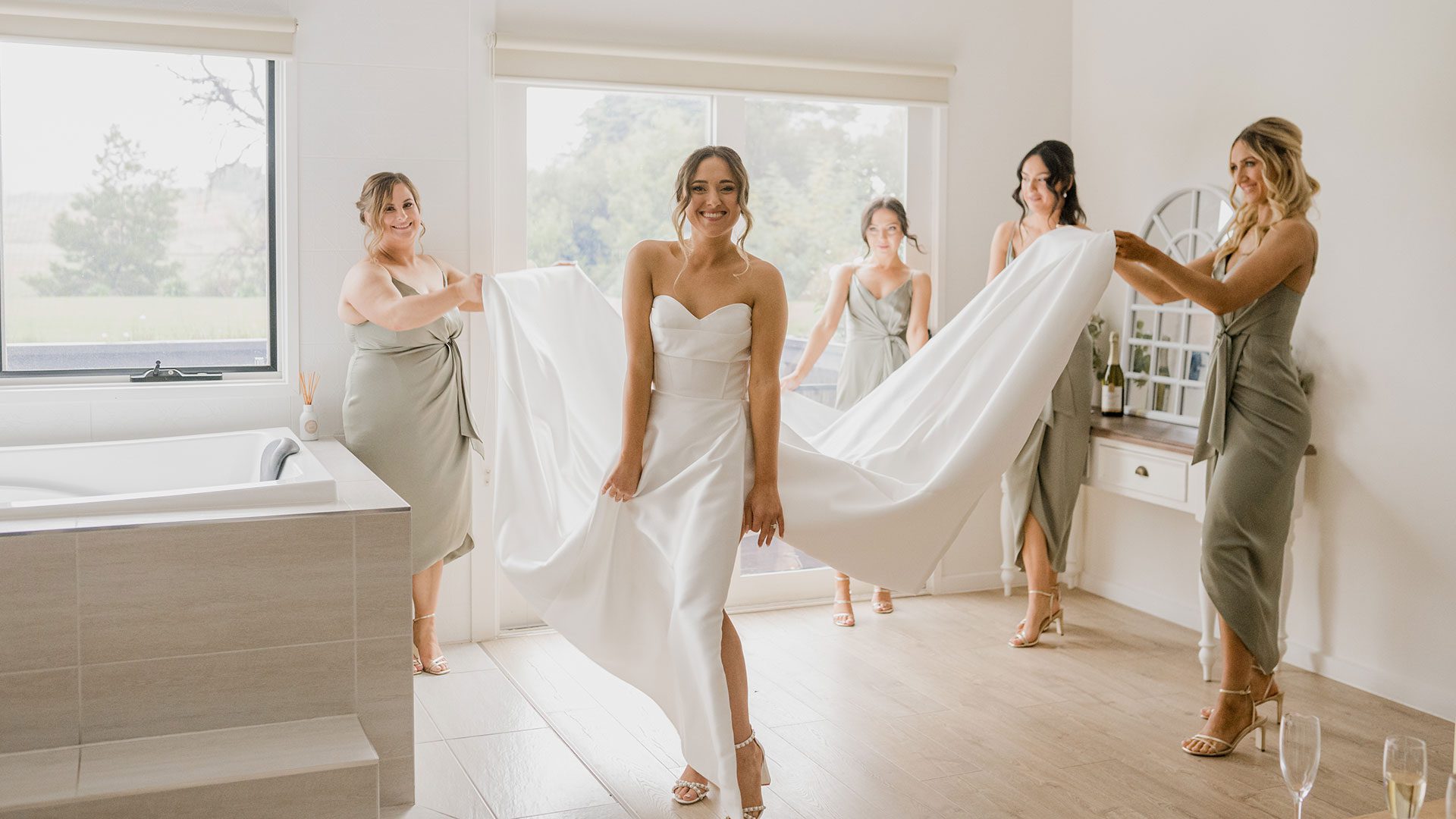
A timeline that breathes looks different on film than one that runs late. The tell is not the set pieces — those happen either way — it is the unhurried minutes around them: people finding each other, the walk between locations, the pause before you go in. Those are the first things a compressed schedule deletes.
A wedding day with room in the schedule — the unhurried minutes around the set pieces
Five scheduling mistakes that cost you photographs
1. A winter ceremony at 4pm
The most common and most expensive. In June the sun is gone by 5:05pm — your portraits are happening in the dark before the reception has even started.
2. Family photographs with no list
Without a written list and a nominated wrangler, ten groupings take 50 minutes instead of 30, and the time comes out of your couple portraits.
3. Booking coverage that ends before the first dance
Ending at 8pm to save an hour frequently means the day’s emotional high point is missing from your gallery. Cut an hour from the morning instead.
4. A portrait location 30 minutes away
An hour of driving buys you the same twenty minutes of photographs you would have had behind the venue. Do it only if the location is genuinely worth an hour.
5. Not telling anyone about golden hour
If the MC does not know, someone will start the speeches while you are outside. One line in the run sheet prevents it.
Questions couples ask
What time should we schedule our wedding ceremony for the best photos?
Work backwards from sunset. In a Melbourne summer, sunset is around 8:30pm, so a 4:00–4:30pm ceremony leaves a comfortable gap before golden-hour portraits. In winter, sunset falls closer to 5:00pm, which means a ceremony no later than 1:30pm if you want couple portraits in daylight. The single most common scheduling error is using a summer template for a winter wedding.
How long do we need for couple portraits?
Fifteen to twenty minutes at golden hour is genuinely enough for a strong set, provided the location is close by. Allow 45–60 minutes if you are travelling to a separate location, because most of that is transit, not photography.
How many hours of coverage should we book?
Eight hours covers the second half of getting ready through to the first dance, which is what most couples want. Ten hours adds the early preparation and some of the party. Under six hours works only if the ceremony and reception are at the same venue and you are happy to skip either the prep or the dancing.
Should we do a first look before the ceremony?
It is a scheduling tool as much as an emotional one. Doing portraits before the ceremony frees the entire gap between ceremony and reception, which matters enormously for a winter wedding when daylight runs out. If tradition matters more to you, keep the reveal and build a longer gap instead.
What happens to the photos if it rains?
Ask your photographer to scout an indoor fallback at the venue during the site visit, not on the morning. Rain is not actually a photographic problem — flat, even light is easy to work with. Lack of a plan is the problem.
How much buffer should we build into the timeline?
Add fifteen minutes after hair and makeup, ten minutes for every vehicle transfer, and fifteen minutes after the ceremony before family photographs begin. Weddings do not run late because of one big delay; they run late because six small ones accumulate with no slack to absorb them.