Melbourne Night View Wedding Photography - City Lights Shooting
Melbourne Night View Wedding Photography - City Lights Shooting
Melbourne Night Wedding Photography: How to Shoot Stunning City Light Portraits After Dark
Most couples stop shooting when the sun goes down. That is their mistake. Melbourne at night is a completely different animal. The city lights up, the streets empty out, and every neon sign, streetlamp, and illuminated building becomes a potential backdrop for portraits that feel edgy, cinematic, and totally unlike anything you would get during the day. Night wedding photography is not easy, but when you get it right, the results are unforgettable.
What Makes Melbourne Nights So Good For Wedding Photos
Melbourne has a reputation for being moody, and honestly, that reputation is earned. The weather shifts fast, the light changes fast, and the city itself has a raw, urban energy that does not exist in polished tourist destinations. At night, that energy amplifies. The laneways glow with warm tungsten light. The Yarra River reflects every color in the skyline. The trams roll past with their headlights cutting streaks through the frame. It is chaotic and beautiful at the same time, and that tension is what makes night wedding photos so compelling.
The biggest advantage of shooting at night is the lack of crowds. Laneways that are packed at 2pm are completely empty by 9pm. You get clean backgrounds, unobstructed sightlines, and the freedom to set up wherever you want without asking strangers to move. For a wedding couple who wants privacy and intimacy, nighttime is a gift.
Understanding City Light as Your Main Light Source
Forget about flash for a moment. At night, the city itself is your strobe. Streetlights, shop signs, car headlights, building windows, neon bars, tram lights, all of it becomes usable light if you know how to see it. The trick is not to fight the available light but to work with it. Every light source has a color temperature and a direction, and your job is to match your couple to the best one.
Warm tungsten from old-school streetlamps gives you that classic golden glow. Cool white LED from modern storefronts creates a cleaner, more editorial look. Neon signs throw colored light onto skin, which can be stunning or disastrous depending on how you use it. The key is to observe first. Spend 10 minutes walking the location before you pick up your camera. Watch where the light falls, where the shadows pool, and where your couple will look best.
The Best Melbourne Spots For Night Wedding Shoots
Not every location works at night. Some spots are too dark, some are too bright, and some have light that looks terrible on skin. You need to pick your ground carefully.
Hosier Lane and the Surrounding Laneways
This is the obvious choice but for good reason. The street art on the walls gets a whole new life under colored light. The lane itself is narrow, which means the light from the shops and bars bounces off both sides and creates this enclosed, warm tunnel effect. Your couple walks through it and every step looks like a scene from a movie.
The trick here is to find the right wall. Not every wall is lit equally. Look for sections where the light hits at an angle, not straight on. Angled light creates shadows and dimension on faces. Straight-on light flattens everything. Also, avoid the sections with too much neon. A little color is great, but too much and your couple looks like they are standing inside a nightclub.
Go between 9pm and 11pm. Earlier than that and the crowds are still around. Later than that and some of the lights start turning off. That two-hour window is your sweet spot.
The Yarra River and Southbank
Southbank at night has a completely different personality. The river acts as a mirror, doubling every light in the skyline. The promenade is wide and open, which gives you room to breathe compositionally. The lights from the casino, the arts center, and the city buildings across the water create a layered backdrop that looks incredible in any frame.
The pedestrian bridges are goldmines. Standing on the bridge with the river below and the city lights behind you gives you depth, leading lines, and reflections all in one shot. The bridge railings create natural frames. The water below catches every color and turns it into a painted surface.
One thing to watch out for: the lights on the bridge itself can be harsh and overhead. They create unflattering shadows under the eyes and chin. Position your couple so the bridge lights are behind them, not above them. Let the city lights across the river do the work.
Federation Square and the CBD Core
If you want something more architectural and less gritty, Federation Square delivers. The geometric patterns of the buildings catch light in interesting ways. The large LED screens throw color onto the ground and onto your couple, which can create some wild, editorial-looking portraits.
The laneways around Flinders Street Station also work well. The station’s yellow facade glows against the dark sky, and the narrow streets around it funnel light in ways that create natural vignettes. The tram lines add leading lines that draw the eye into the frame.
The CBD core around Collins Street and Bourke Street gives you tall buildings, bright shop windows, and that dense urban energy that screams city wedding. The light here is mixed, which means you need to be deliberate about your white balance, but the results are worth the extra effort.
Camera Settings That Actually Work At Night
Night photography is technically demanding. If you do not dial in your settings before you shoot, you will spend hours trying to fix images that were ruined in-camera.
Dialing In Exposure and White Balance
Shoot manual. There is no other option at night. Start with an aperture of f/1.4 to f/2.8 if you want that shallow depth of field with creamy bokeh in the background lights. If you want more of the scene in focus, stop down to f/4 or f/5.6, but be aware that smaller apertures let in less light and you will need to compensate with ISO or shutter speed.
Shutter speed is your balancing act. If you are handheld, do not go below 1/60th of a second or you will get motion blur from your own hands. If you have a tripod, you can go as slow as you need. For walking shots, 1/30th to 1/60th usually works if your couple moves slowly.
ISO is where night photography gets tricky. Push it to 1600 or 3200 if you have to. Modern cameras handle high ISO much better than they used to. You will get some noise, but a little grain actually adds to the mood of night photos. It looks film-like and raw, which is exactly the aesthetic most couples want for their night session.
White balance is critical. Do not trust auto. Tungsten streetlights are around 3200K and they will make everything look orange if you let the camera compensate. Set your white balance manually to around 3800K to 4200K to keep the warmth without letting it go overboard. If you are mixing light sources, like tungsten streetlights with cool LED signs, pick one dominant source and set your white balance to match it. The mixed colors can actually work in your favor if you embrace them.
Using Available Light Creatively
The best night wedding photos are not lit by any artificial light you bring. They are lit by the city. Find a streetlamp and put your couple under it. The light falls from above and creates that classic Rembrandt triangle on their faces. Find a neon sign and let it throw color across one side of their face. Find a shop window and use it as a giant softbox.
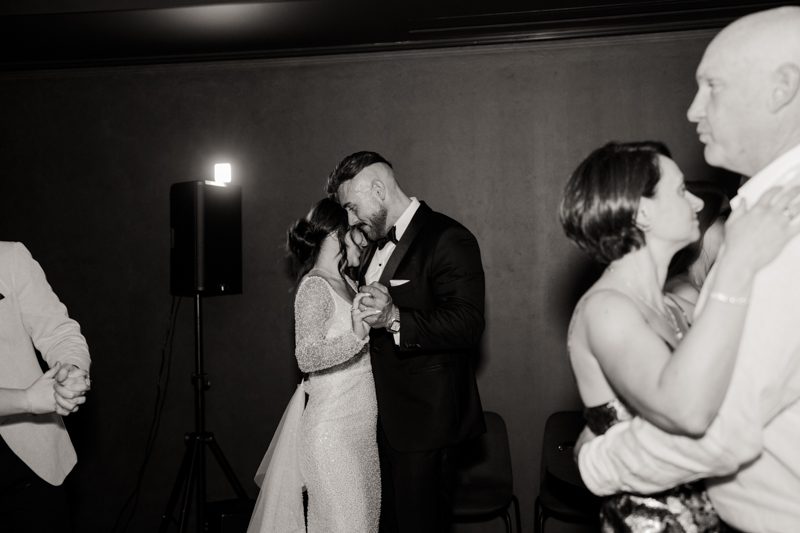
Backlighting works incredibly well at night. Put a bright light source behind your couple and let it rim their hair and shoulders. The dark foreground contrasts with the bright background and your couple pops out of the frame. This is one of the easiest ways to get a dramatic night portrait without any special equipment.
Reflections are your secret tool. Puddles, wet pavement, car windshields, glass buildings, all of them give you a second image for free. A couple standing on wet ground with their reflection below them looks like two people in a dream. Get low and shoot into the puddle. The reflection will be slightly distorted, which adds to the surreal quality of the image.
Common Mistakes That Ruin Night Wedding Shoots
The first mistake is shooting too early. If you start at 8pm in summer, the sky is still blue and the city lights have not fully popped. Wait until it is properly dark. The sky should be black or deep navy, not purple. The lights need to be the dominant source in the frame, and that only happens after full darkness.
The second mistake is over-lighting. Couples want to see their faces, so they ask for flash. Resist this urge. Flash at night looks artificial and kills the mood. The whole point of night photography is to let the city light do the work. If the faces are too dark, lift them in post. A little shadow on a face at night is not a problem, it is an asset.
The third mistake is ignoring the background. During the day, you can blow out a busy background with a wide aperture. At night, every light in the background becomes a bokeh circle. If there is a trash can, a random car, or an ugly sign behind your couple, it will show up as a distracting blob of light. Scout the background before you shoot. Move your couple a few feet to the left or right if it cleans up the frame.
Making The Most Of Your Night Session
Night sessions are short. You have maybe two to three hours of usable darkness before the light shifts or the couple gets tired. Use that time wisely.
Start with the widest, most scenic shots. Get the big environment portraits out of the way while the energy is high. Then move into tighter shots in the laneways and on the bridges. Save the most intimate, close-up portraits for last when your couple is relaxed and the mood is settled.
Bring a small portable light if you must, but use it sparingly. A single LED panel held low and to the side can fill in shadows on faces without looking like a flash. It gives you control without killing the natural feel.
And shoot more than you think you need. Night photography has a higher miss rate than daylight. Frames that looked perfect on the back of your camera often turn out noisy or underexposed when you get home. Give yourself a buffer. The couple will thank you when they see how many keepers you delivered.