Melbourne wedding photography with a seaside atmosphere and a beautiful style
Melbourne wedding photography with a seaside atmosphere and a beautiful style
Melbourne Wedding Photography: Capturing That Ocean-Edge Dream
There is something about standing at the edge of water on your wedding day that makes everything feel bigger. The wind catches your veil, the horizon stretches forever, and the light does things that no studio could ever replicate. Melbourne might not sit on the Pacific, but its coastline is wildly dramatic — wild beaches, crumbling piers, rocky cliffs, and sunsets that turn the sky into something almost unreal. For couples who want their wedding photos to feel like a film they keep rewatching, the coast is where it happens.

Why Melbourne’s Coastline Is Different
Most people think of Australian beaches asBondi-style — golden sand, turquoise water, surfer vibes. Melbourne’s coast is not that. It is moodier, wilder, and infinitely more photogenic. The water is cold and dark, the sand is grey-gold, the cliffs are basalt and sandstone, and the light here has a quality that photographers spend years chasing — low, golden, and always changing.
St Kilda is the obvious starting point. The pier stretching into Port Phillip Bay, the old bathing pavilion, the palm trees that look slightly out of place against the grey sky — it all feels like a European seaside town that got lost in the Southern Hemisphere. Early morning here, when the fishermen are out and the tourists are still asleep, the pier is empty and the water is flat as glass. A couple walking to the end of it, silhouetted against a pale pink sky, looks like the opening scene of something beautiful.
Brighton Beach offers a different energy — wider, wilder, more exposed. The bathing boxes line the shore in a row of faded pastels, and behind them the beach stretches for miles. The sand here is firm and wet near the waterline, which means reflections — endless reflections — that double every image. Shooting at low tide, when the wet sand becomes a mirror, creates frames that look like paintings. The sky takes up two-thirds of the image, the couple is small in the frame, and the whole thing feels vast and tender at the same time.
Portsea and Sorrento on the Mornington Peninsula push the coastal drama even further. The cliffs here are dramatic — sheer rock dropping into green-blue water, with wildflowers growing in the cracks. The light at Portsea Back Beach is extraordinary in late afternoon, when the sun dips low and turns the basalt cliffs warm orange while the water stays cool and blue. That contrast — warm rock, cool water — is the visual signature of Melbourne’s best coastal photography.
The Piers and Jetties That Steal Every Frame
Melbourne has more piers per capita than almost anywhere on earth, and every single one of them is a wedding photography goldmine.
St Kilda Pier at Dawn
Getting to St Kilda Pier before sunrise is worth the alarm clock. The metal structure glows in the first light, the water is still, and the city skyline across the bay is just waking up. Walking slowly down the pier with a partner, hand in hand, with nothing but water and sky on either side — that is the kind of image that stops people scrolling. The symmetry of the pier creates natural leading lines that draw the eye straight to the couple. The metal railings catch early light and create warm streaks across the frame.
The old kiosk at the end of the pier adds character — peeling paint, rusted iron, sea-worn wood. Leaning against the railing with the kiosk behind you, wind in your hair, city lights still faintly visible across the water — it feels cinematic without trying. This is not a location that needs styling. It needs patience and good timing.
Williamstown and the Hobsons Bay Coast
Further west, Williamstown Beach and the Pier offer a quieter, more industrial feel. The old shipping containers, the crane silhouettes, the wide expanse of bay — it feels like a working port that happens to be beautiful. The light here comes from the west, which means golden hour is spectacular. The sun sets over the city, painting the water gold and pink, and the pier becomes a dark line cutting across a burning sky.
The Newport Power Station nearby is not exactly romantic, but its massive brick chimney and industrial scale create a striking backdrop when paired with a couple in formal wear. The contrast between the raw, heavy architecture and the softness of a wedding dress is visually arresting — it says something about the couple, about strength meeting tenderness.
The Mornington Peninsula Jetties
Down south, Red Hill and Flinders have small wooden jetties that jut into Western Port Bay. These are tiny, unassuming, and absolutely perfect. A couple standing at the end of a weathered jetty, water on both sides, the peninsula hills rolling behind them — the composition is simple but the feeling is enormous. The wood is grey and silver, the water is dark green, and the sky is usually doing something dramatic. These are the frames that end up printed large and hung on walls.
Rocky Coasts and Cliff-Edge Drama
Not all Melbourne coast is sand. Some of the most stunning wedding photos come from the rocky stretches where the land meets the sea with force.
The Twelve Apostles Road and Loch Ard Gorge
Okay, the Twelve Apostles are three hours away, but the Great Ocean Road coast near Torquay and Jan Jump is close enough for a day trip and equally dramatic. The limestone cliffs, the crashing waves, the sea stacks rising from white foam — it looks like the edge of the world. A couple standing on a cliff top with the ocean churning below them creates an image that feels epic and intimate at the same time. The wind here is relentless, which means veils fly, hair moves, and everything looks alive.
Closer to Melbourne, Dromana and the Nepean Highway coast has accessible lookouts with sweeping views of Bass Strait. The rocks are red-brown, the water is deep blue, and the light in the late afternoon turns everything warm. Standing on a rocky outcrop with the sea stretching to the horizon behind you — there is no better backdrop for a wide, cinematic wedding portrait.
Point Ormond and Elwood Cliffs
Point Ormond in Elwood is a hidden gem most Melbourne brides do not know about. The old bathing house sits on a cliff above the beach, and the path down to the water winds through native bush. The light here is dappled and green in the morning, then golden and open in the evening. Shooting from the clifftop looking down at the beach gives you layers — the couple in the foreground, the beach below, the bay beyond, the city skyline on the horizon. That depth is what makes coastal photography feel grand rather than just pretty.
The Light That Makes Everything Magical
Coastal photography lives and dies on light, and Melbourne’s coast has some of the best light in the country.
Golden Hour on the Water
The hour before sunset on any Melbourne beach turns the world into a painting. The water goes from grey-blue to liquid gold. The sand warms. The sky does things that look impossible — pinks bleeding into oranges, oranges into purple, purple into deep blue. This is when you shoot your wide, epic frames — the couple small against the vast, glowing horizon.
The trick is to position the couple so the sun is behind them or to the side. Backlighting creates a halo effect around hair and veils that looks ethereal. Side lighting sculpts faces and creates long shadows on the sand that add depth. Front lighting is flat and boring — avoid it unless you want a passport photo.
Blue Hour and the Afterglow
Do not pack up when the sun disappears. The twenty minutes after sunset — blue hour — are when the coast gets truly magical. The sky goes deep indigo, the city lights start twinkling across the bay, and the water turns dark and reflective. A couple standing on a pier or a beach at blue hour, lit only by the ambient glow of the sky, looks like a memory. The images are moody, quiet, and deeply romantic — the kind you look at in ten years and feel something in your chest.
Overcast Coastal Days
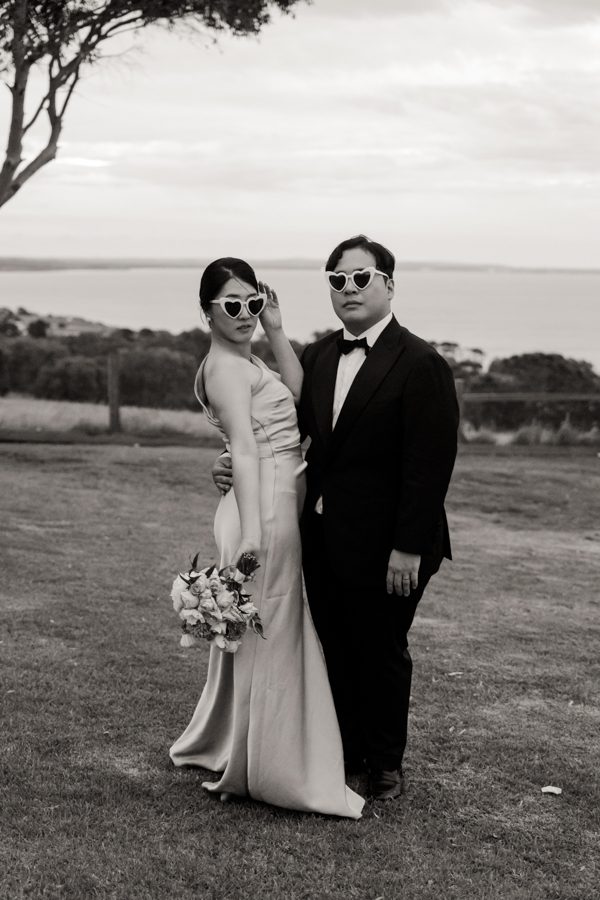
Melbourne is overcast more than it is sunny, and on the coast that overcast sky is actually a gift. Grey clouds act as a giant softbox, diffusing the light and eliminating harsh shadows. The water turns silver-grey, the sand goes warm beige, and the whole scene looks like a black-and-white photograph that happens to be in color. Overcast coastal light is the most flattering for skin tones and the most moody for wide shots. Do not cancel because of clouds — embrace them.
Styling That Works With the Coast
The coast demands a different approach to styling than a ballroom or a garden. The wind, the salt air, the sand — all of it affects how clothes and hair behave, and that is actually part of the beauty.
Dresses That Move With the Wind
Heavy ballgowns fight the wind and look stiff. Flowy chiffon, lightweight crepe, or soft tulle with a long train — these fabrics catch the breeze and create movement that looks alive on camera. A train blowing sideways in the wind, a veil streaming behind, hair lifting off the neck — these are the details that make coastal wedding photos feel dynamic rather than static.
Colors that work: ivory, blush, soft champagne, or a muted dusty blue that echoes the water. Avoid pure white — it blows out against bright sand and sky. A warm cream picks up the golden light and glows.
Groom Styling That Does Not Fight the Elements
Linen suits in oatmeal, stone, or light grey are perfect for the coast. They wrinkle slightly in the wind, which actually adds character — a perfectly pressed suit looks out of place on a beach. Roll the sleeves, skip the tie or go with a loose silk one, and let the wind do its work. Bare feet on sand, shoes in hand — that casual, unpolished look is exactly what coastal photography needs.
Hair and Makeup for Salt Air
Humidity and wind will destroy any elaborate updo within minutes. Embrace it. Loose waves, a low messy bun, or simply hair down and wind-tousled. Makeup should be minimal — dewy skin, groomed brows, a lip that survives the breeze. The goal is to look like you were born on a beach, not like you spent three hours in a chair before getting there.
Shooting Techniques That Elevate Coastal Work
A few technical choices can take coastal wedding photography from nice to unforgettable.
Shoot Low and Wide
Get down close to the sand. A low angle shot with the couple in the foreground and the vast sky behind them creates a sense of scale that makes the image feel epic. The wet sand near the waterline acts as a natural reflector, bouncing light back up onto faces and filling shadows. It also creates mirror images that double the visual interest.
Use the Horizon Deliberately
Where you place the horizon line changes everything. Low horizon — sky taking up most of the frame — feels open and airy. High horizon — water and sand dominating — feels grounded and intimate. For the dreamy, floating feeling that coastal weddings are known for, put the horizon in the lower third and let the sky do the talking.
Embrace the Grain and the Wind
Do not fight the elements. Let the wind blur the veil slightly. Let the grain from a high ISO add texture. Let a wave crash in the background out of focus. Perfection is the enemy of atmosphere. The best coastal wedding photos look like they were taken in a hurry by someone who was too busy looking at the view to worry about sharpness. That carelessness is what makes them feel real.
Melbourne’s coast is not tropical. It is not warm. It is not predictable. And that is exactly why it photographs so beautifully. The drama of the cliffs, the mood of the grey water, the wildness of the wind — it all adds up to something that no tropical beach could ever replicate. The coast here does not ask you to look perfect. It asks you to look real. And that is the most beautiful thing a wedding photograph can do.