Melbourne wedding photography with a cinematic and story-driven approach
Melbourne wedding photography with a cinematic and story-driven approach
Cinematic Storytelling Wedding Photography in Melbourne: Shoot Your Love Like a Film
Some wedding albums read like a photo shoot. Others read like a movie you never want to end. The difference is not gear or location — it is intention. Cinematic wedding photography is about building tension, capturing silence, and letting small moments carry the weight of big emotions. Melbourne, with its moody light, European bones, and endless variety of textures, is one of the few cities that can genuinely stand in for Paris, London, or Rome without a single plane ticket. Here is how to shoot your wedding day like it matters — because it does.
Choosing Locations That Already Feel Like a Set
A great cinematic shot starts before you press the shutter. You need a place that already has atmosphere — somewhere the light falls in a certain way, where the walls have a story, where the air feels thick with possibility.
Old Money Interiors and Hidden Mansions
Melbourne is full of interiors that look like they were built for a Merchant Ivory film. Rippon Lea in Elsternwick is the obvious standout — a 1868 mansion with ballroom ceilings, marble fireplaces, and gardens that slope down to the Yarra River. But what makes it cinematic is not the grandeur; it is the quiet corners. The hallway where light falls through a stained glass window onto dusty floorboards. The library where someone once sat reading for hours. These are not backdrops — they are characters in your story.
Como House in South Yarra offers a different flavor — more intimate, more personal, with Art Deco details and a garden that feels private even though it sits minutes from the city. Shooting here at dusk, when the interior lamps come on and the garden goes blue, gives you that warm-inside-cool-outside contrast that cinematographers spend careers chasing.
Lesser-known gems like Coombe Cottage in Yarra Glen or Glenview Mansion in Glenhuntly bring period authenticity without the crowds. Wood paneling, leadlight windows, original fireplaces — these spaces demand that you slow down and let the room breathe. A couple standing in a doorway, backlit by a single window, says more than any posed portrait ever could.
Urban Decay Meets Modern Edge
Cinema is not always pretty. Sometimes the most powerful frames come from places that are rough, unfinished, or slightly forgotten. The abandoned buildings along the Yarra River in Footscray and Yarraville have become a favorite for editorial wedding work. Corrugated iron, shattered glass, wild grass pushing through concrete — it is all raw material for a love story that does not need polishing.
The interior of old churches like St James Old Cathedral on King Street offers dramatic vertical space and shadow play that no studio can replicate. Standing in the nave with nothing but a single shaft of light cutting across the pews creates an image that feels sacred and cinematic at the same time. The echo of footsteps on stone, the smell of old wood and candle wax — these sensory details seep into the photographs even though you cannot see or smell them. It is the kind of place where a whisper feels loud.
Industrial spaces in Newport and Spotswood — old factories, loading docks, railway corridors — bring a grittier narrative. Rust and steel and concrete create a palette that is cold and beautiful. A couple embracing in front of a massive rolling door, backlit by the pale Melbourne sky, reads like the final scene of an indie film. It is unglamorous in the best way — real, textured, honest.
The Art of Building a Visual Narrative
A cinematic wedding album is not a collection of pretty pictures. It is a sequence. It has a beginning, a middle, and an end. It has quiet scenes and loud ones. It has wide establishing shots and tight intimate close-ups. Thinking in terms of story changes everything about how you approach the day.
The Opening: Establishing the World
Start with wide shots that set the scene. A city skyline at dawn. An empty street. A door opening. A hand reaching for a coffee cup. These are your establishing shots — they tell the viewer where we are and what the mood is. In Melbourne, shooting from the Southbank promenade at first light gives you the river, the skyline, and that pale golden glow that looks like it belongs in a Wong Kar-wai film. Or walk through Flinders Street Station before it wakes up — the vast arched ceiling, the empty platforms, the echo of a single suitcase wheel on tile. It is lonely and beautiful and it sets the tone for everything that follows.
The Middle: Tension, Intimacy, and In-Between Moments
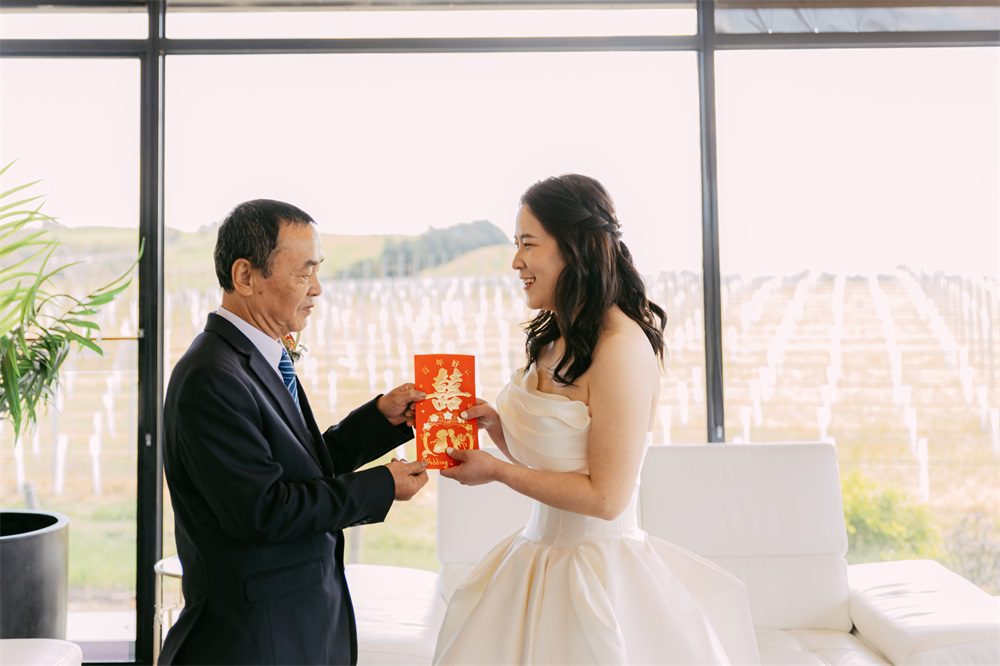
This is where most wedding albums fall apart — too many group shots, too many posed smiles, not enough feeling. The cinematic approach fills the middle with the stuff that actually matters. The look between a bride and her father before the ceremony. The groom pacing outside, loosening his tie. A bridesmaid fixing a flower that keeps falling. These are not the moments you plan — they are the moments you notice.
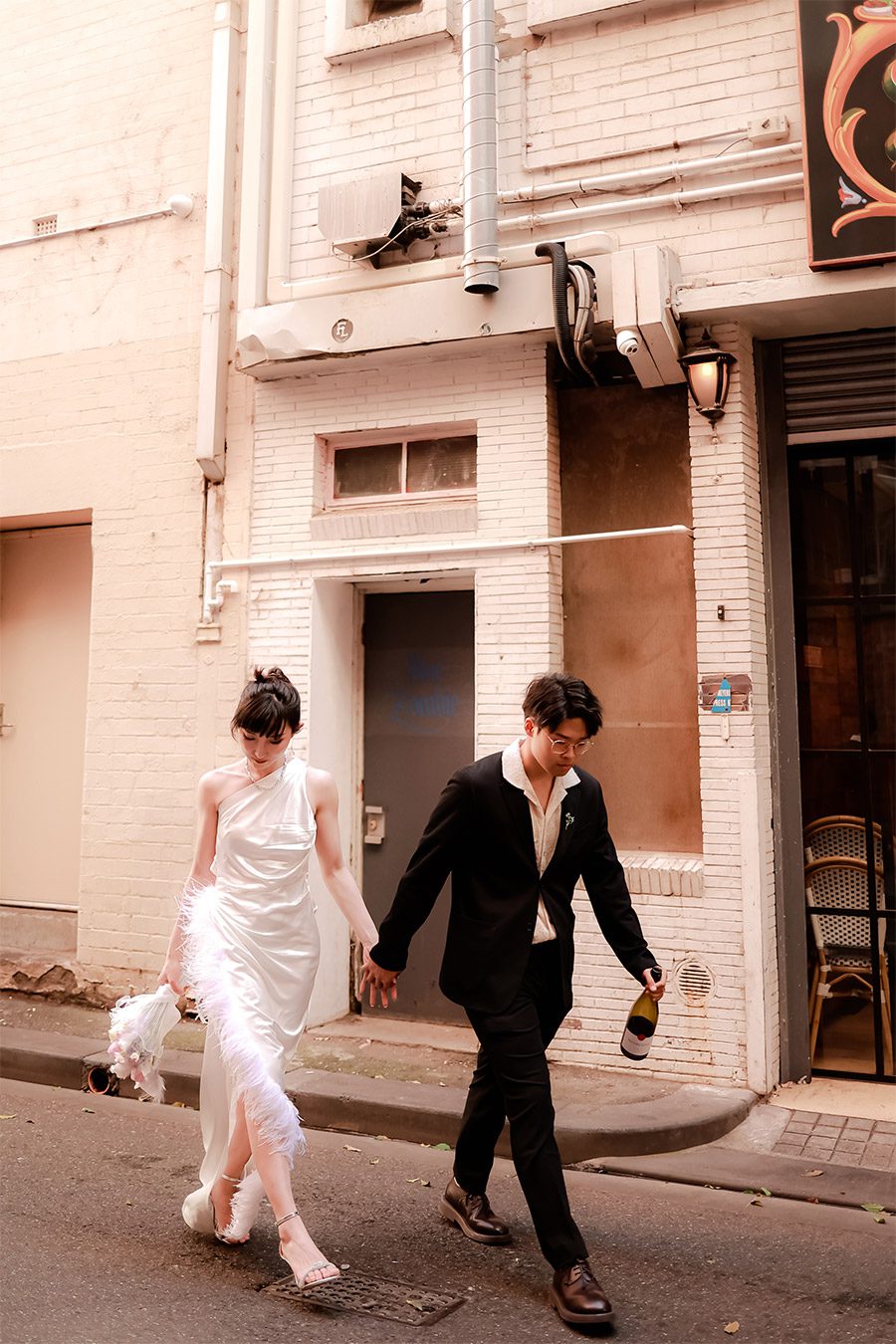
Walking sequences are the backbone of cinematic wedding photography. A couple moving through a space — down a laneway, across a bridge, through a market — creates movement and rhythm that static portraits cannot. Shoot them from behind, from the side, from a distance. Let the environment frame them. In Melbourne, a walk along Alexandra Gardens in Yarra Bend or through the bluestone streets of Carlton gives you tree-lined paths, old fences, and soft dappled light that turns a simple stroll into something poetic.
Rain is your best friend here. Melbourne’s sudden downpours are not a problem — they are a gift. A couple running through a wet street, laughing, coats flapping, water splashing — this is pure cinema. The reflections on wet pavement double the visual interest. The mood shifts from bright to moody in seconds. Shooting in rain requires trust — trust in your photographer, trust in the weather, trust that the messy moments will become the best ones.
The Closing: Emotion Without Words
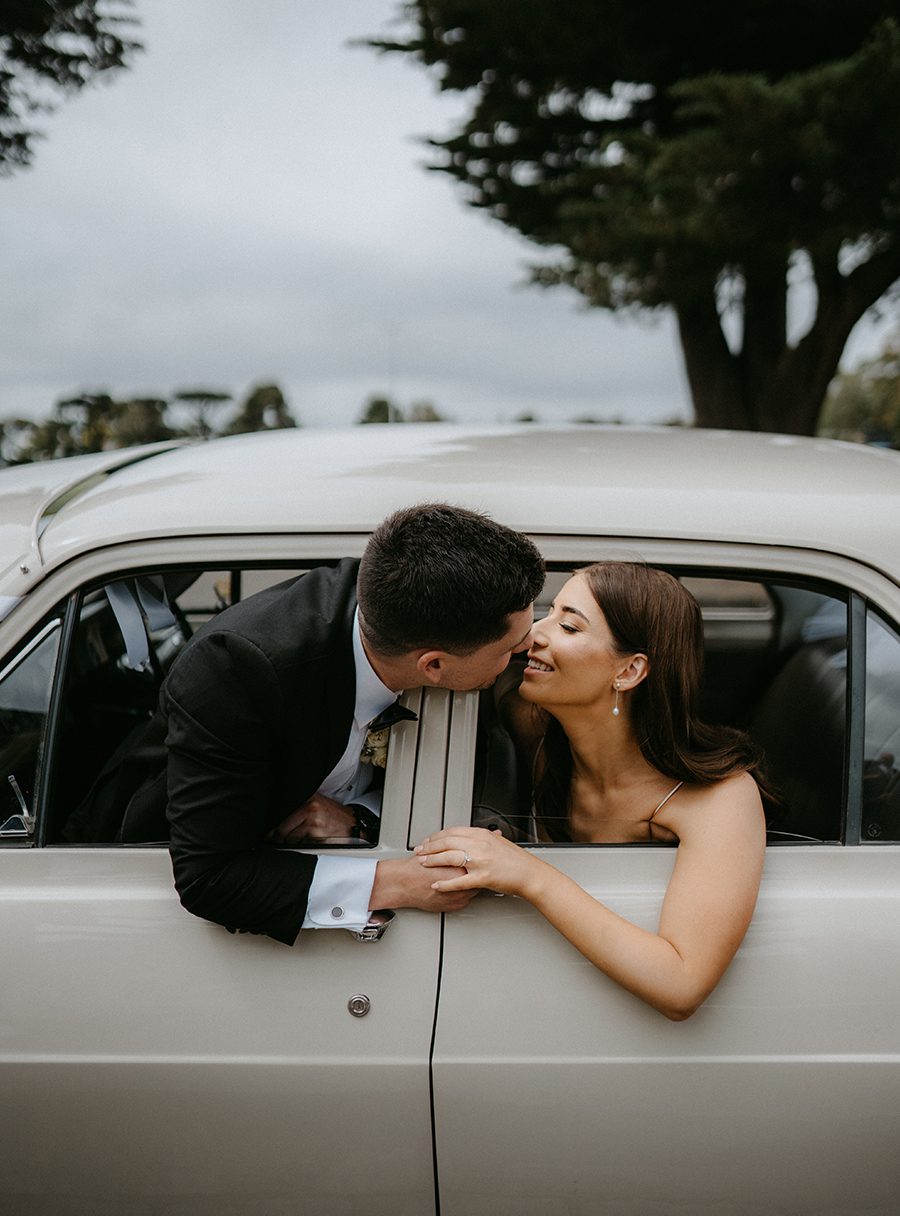
The final images in a cinematic album should leave the viewer with a feeling, not a fact. Not “they got married at this venue” but “I felt something when I saw this.” This usually means getting close — really close. Hands intertwined. A forehead resting against a forehead. A tear that was not wiped away in time. The camera becomes a witness, not a director.
Golden hour on the beach is the classic closer, and for good reason. St Kilda Pier at sunset or Brighton Beach as the last light hits the water gives you warm side light, long shadows, and an open horizon that makes everything feel vast and tender. A couple silhouetted against a burning sky, standing still while the world moves around them — that is the last frame of a beautiful film.
Light as the Invisible Director
You cannot talk about cinematic photography without talking about light, because light is what separates a snapshot from a scene. Melbourne’s light is particular — it comes in low and slanted, it changes fast, it goes from flat white to deep amber in twenty minutes. Learning to work with it rather than against it is the single biggest skill a cinematic photographer develops.
Chasing Overcast and Moody Skies
Most couples want sunshine. Cinematic photographers want clouds. Overcast skies in Melbourne act as a massive diffuser — soft, even light that wraps around faces and eliminates every harsh shadow. It is the most flattering light for skin tones and the most moody for architecture. A grey sky over the Dandenong Ranges turns the forest into a painting — muted greens, silver trunks, mist hanging between the trees. It looks like the opening scene of a drama nobody wants to end.
The thirty minutes before rain is another sweet spot. The sky goes dark and heavy, the light turns blue-grey, and everything in the frame gets a little more intense. Shooting in Fitzroy or Collingwood during a pre-storm sky gives you that dramatic contrast between the dark clouds and the warm glow of streetlights and shop windows. It is moody without being sad — cinematic without being pretentious.
Window Light and Interior Drama
Indoor cinematic work relies almost entirely on window light. Large sash windows in Victorian terraces along Lygon Street or Drummond Street throw long rectangles of soft light across wooden floors. Position your couple near the window, let the light fall on one side of their face, and let the other side fall into shadow. That half-lit, half-dark look is the visual signature of almost every great film ever made.
Older venues with small windows and high ceilings — think church halls, heritage hotels, converted warehouses — create natural chiaroscuro. The light comes in narrow and directional, painting stripes across walls and faces. It is dramatic and unpredictable and it forces you to be patient. You wait for the cloud to move, for the angle to shift, for the light to hit just right. That waiting is part of the process — and part of the story.
Editing That Feels Like a Film, Not a Filter
The shoot is only half the equation. How the images are treated afterward determines whether they feel like cinema or like a social media post with a vintage filter. Cinematic editing means desaturating selectively — keeping skin tones warm while pulling the greens and blues toward teal. It means adding grain, not because the photo is bad, but because film grain is part of the visual language of cinema. It means cropping wide — 2.39:1 aspect ratio, the anamorphic widescreen that every movie uses — because it forces the viewer to look at the whole frame, not just the faces.
Subtle vignetting draws the eye to the center. Slight color shifts in the shadows — cool blues, warm ambers — create depth that flat editing cannot. The goal is not to make the photos look old. The goal is to make them feel like they belong to a story that is still unfolding.
Melbourne gives you every tool you need — the architecture, the light, the weather, the streets, the people. What it cannot give you is the willingness to be still, to be quiet, to let a moment happen without trying to control it. That part is yours. Walk slowly. Look at each other. Let the city be the set and let your love be the plot. The camera will follow.